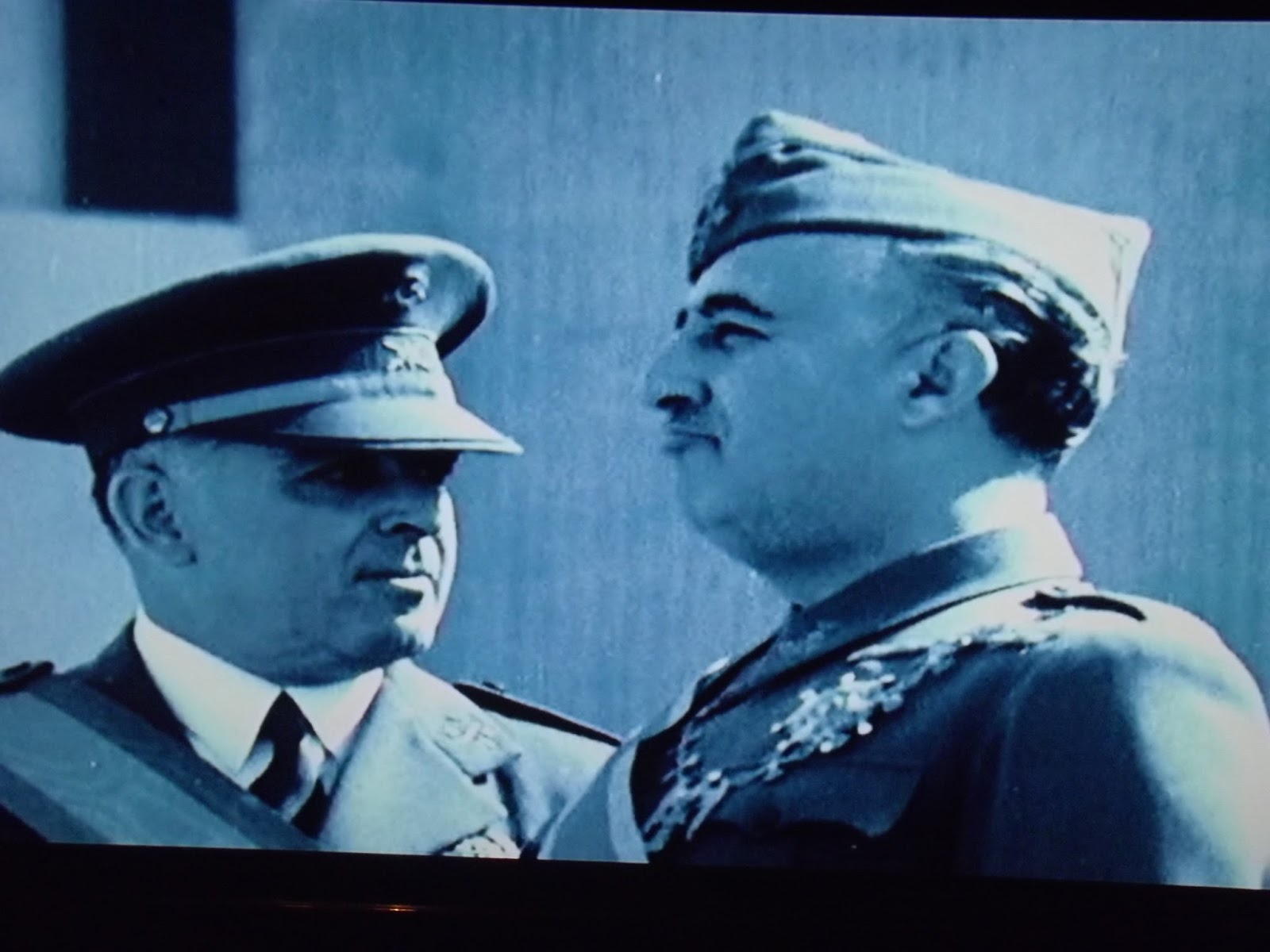
-Media Archaeology-
THE GOAL
The main aim of the paper presented is to debate and to
inform about the increasing use of stock footage in historical movies and
feature films which are introduced to viewers as a fictional piece of art only.
Some film directors have made statements about the issue of creating
fictional movies by using shots of real events and persons. The research of
about four thousand movies and documentaries have revealed the assumption that
fiction is not fiction in fictional movies and in historical films. The paper
will also deal with some of the reasons for secret and hidden use of material
kept in audiovisual archives.
DEFINITIONS
Stock footage, archive footage , newsreels, documentary film and stock shots
are concepts that need to be defined and explained to understand the result of
the research done to discover hidden use of real shots in movies.
Stock footage and archival footage: Recorded material, such
as film footage and videotape footage, that is stored and kept by a television
company ,a television corporation, a television network or other media outlet
archived to be broadcast when a subject relating to images in the material is
discussed.
Stock shot: A single piece of stock footage is called ”
stock shot” or ” library shot”.
Newsreels: A short documentary film containing filmed news stories and items of topical interest. Newsreels are
considered significant historical documents because the films are often the
only audiovisual record of historical and cultural events of those times.
The history of newsreels: Short documentaries regulary released between 1910 to 1960 in a public
presentation place containing political
news, current affairs and daily life matters. The new television companies made
their own newsreels for transmission. Therefore the making of newsreels died
out. Cuba, Japan and Spain continued
producing newsreels into the 1980s and 1990s.
Documentary film/videotape: A broad category of visual
expression that is based on the attempt to document reality. Stock footage
is used intended to make some aspect of reality but the shots have to be used
in the correct context.
THE SOURCE FOR THE RESEARCH AFTER HIDDEN EXCERPTS USED IN
MOVIES

The main source for my research was my private collections
of movies and documentries contenting about four thousands films.The movies
have been viewed more than once and photos have been taken to show the excerpts
used. The result of the research have led to many discoveries of incorrect
incorporation of stock footage in documentries produced and transmitted by
television companies worldwide. The incorrect use or misuse of stock shots
discovered will not be dealt with in this paper written to document the active
and secret use of real shots in movies only. The Credits lists of and the
official critics of the movies were
important objects for the research after archival footage used in the
films selected.
ARCHIVAL FOOTAGE IN MOVIES
To highlight the issue of making use of real shots in
movies, six movies have been selected to illustrate the difficulties in finding archival footage used in the movies.
The selected movies are:
-Casablanca
-Persona
-En pasjon(English title: The Passion of Anna )
-Hemngway & Gellhorn
-Ashes and Diamonds
-Uprising
Some facts about the movies.
CASABLANCA was released in 1942. The film is directed by
Michael Curtiz. The main actors are: Ingrid Bergman, Humphrey Bogart and Paul
Henreid. The plot of the film is about an American expatriate who must make a
choice between his love for a woman or helping her husband who is a Czech Resistance leader making
an escape from Casablanca. The French city was
controlled by the French Vichy rule of France. The film is not an
American romantic drama film only. No. It is a film dealing with international conflicts leading up to the
outbreak of the Second World War. It is a political film contenting talks about the reasons for the fight for a democratic society and an attack on the
policy of the Nazi German wanting to
occupy country after country.
The film was not made in Casablanca but at Warner
Bros.Studios in Burbank, California, USA. An exception is the sequence at Van
Nuys Airport in Van Nuys, Los Angeles, USA.
The City of Casablanca has made an attempt making tourists
believe that the famous ” Rick’s Cafe Americain” was situated in th Ciy of
Casablanca. As a tourist in Casablanca some years ago I found ” Rick’s
Cafe Americain”.
The song ” As Time
Goes By ” by Herman Hupfeld is played in
the movie.
PERSONA was released in 1966. The film is directed ,
produced and written by Ingmar Bergman.The main actors are: Liv Ullmann, Bibi
Andersson, Gunnar Bjørnstad and Margaretha Krook.The plot is about an encounter
between two women: A successful actress who became mute and a nurse charged
with caring her. The themes of, Persona, are duality, insanity and personal
identity.
The working titles of, Persona, were many: Sonat før två
kvinnor( Sonata for two Women), Ett stycke kinematografi ( A Piece of
Cinematography), Opus 27, and Kinematografi.
EN PASJON was released in 1968. The film is directed by
Ingmar Bergman. The main actors are: Bibi Andersson, Max von Sydow. The English
title is: The Passion of Anna.The plot is about a man struggling with the
recent demise of his marriage. On the island where he lives alone he meets a
woman who is grieving the deaths of her husband and son. The story is also
about the relationship between the two persons who are struggling with private
emotional problems.
HEMINGWAY &
GELLHORN was released in 2012. The film is directed by Philip Kaufman. The main
actors are: Nicol Kidman and Clive Owen.
The film is about the relationship between the American
journalist Martha Gellhorn and the American writer Ernest Hemingway. The movie
begins in 1936 in Key West, Florida, USA. The plot deals with the career of the
famous American journalist and writer, Ernest Hemingway and the American
journalist Martha Gellhorn. They are covering the Spanish Civil War, working
with the production of the documentary ,
The Spanish Earth, together with, Joris Ivens, covering the war in China,
making an interview with Chiang Kai-shek, and they also get married. Both are
active during the Second World War as journalists. The relationship between the
two journalistas are dramatic and
complicated.
ASHES AND DIAMONDS (Original title: Popiol i diament) was
released in 1958. The film is directed by Andrzei Wajda. The main actors are:
Zbigniew Cybulski, Adam Pawlikowski and Waclaw Zastrzezynski.
The film is based on a novel written by the Polish writer,
Jerzy Andrejewski.The plot of the film is the critical political and military
situation in Poland in May 1945. Two former Home Army soldiers have been
assigned to assassinate a communist commissar. The first attempt to kill the
commissar failed. The main person in the film, Maciek, made it the second time.
He was killed later on.
A Special Jury Prize at Cannes Film Festival in 1957 awarded
the film together with Ingmar Bergmans film, The Seventh Seal.
UPRISING was released in 2001. The film is directed by Jon
Avnt. The main actors are: Leelee Sobieski, Hank Azaria, David Schwimmer, Jon
Voight and Donald Sutherland. The plot
is about the Polish Jews who were imprisoned in the Warsaw Ghetto. In 1943 a
revolt against the Nazi German soldiers
took place. The rebellion held back the German soldiers for almost a
month in 1943. Half-a-million Polish Jews were imprisoned in the ghetto in
Warsaw. The story presented is a fictional story based on events that took
place. It is not the aim of the film to describe the tragic events as a correct
historical report.
SOME REASONS FOR MAKING USE OF ARCHIVAL FOOTAGE IN NEW
MOVIES
-For economic reasons only. It is less expensive making
copies of films which were made during a battle or any other historical events
than making a reconstruction of the battle or the events.
-To make moviegoers aware of the time of the historical
events dealt with in films.
-To avoid making reconstructions of the events in television
or film studios.
-Because the reality is better on television news than news
made in the studio.
-Copyright is no problem when it comes to use German made
newsreels or films from WWII.
-To portrait a person by using shots of the person might
make the movie better than using expensive actors.
-Statements made by official persons are important to
portrait persons later on.
HOW THE STOCK FOOTAGE HAS BEEN USED IN THE SIX MOVIES
SELECTED FOR THE PRESENTATION
”…the Devil is in the Details…”
The discovery of implication of scenes and shots of archival
footage in fictional movies is a task for dedicated media searchers, media
librarions and above all: Media archaeologists. The work is time consuming.
Credits lists have been studied searching for the sources used. But the credits
lists are not reliable sources. No
information about the use of stock footage was found on the credits lists of
the movies, Persona, and ,Ashes and Diamonds. A reliable source was reading
critics of the movies where the writers who had evaluated the films in details.
CASABLANCA
In the movie, Casablanca, the use of archival footage is not
easy to discover by viewers. You have to
study the scenes of the film frame by frame. Casablanca is made in black and
white film. The few seconds of archival footage is taken from German black and white newsreels. The shots
described the German invasion of France. German soldiers are advancing towards
Paris.
PERSONA
In the movie,
Persona, it is easy to find the archival footage used. The Norwegian actress,
Liv Ullmann is viewing a television programme. The television set is set up in
the room where she stays. The sceen selected for the film is television news of
a Vietnamese monk, Thich Quang Durc, in Saigon burning themselves to death with
gasoline. The television newsreels made the reality as real as possible. A
photo taken in the Warsawa Ghetto was shown too.The photo is taken from an
official report prepared by General Jurgen Stroop for the SS chief Heinrich
Himmler.The report is referred to as ” The Stroop Report ”. The original title
of the report is: ” The Jewish Quarter of Warsaw is No More!” ( German title: Es
gipt keinen judischen Wohnbezirk in Warschau mehr!). No fiction. Persona was
also made in black and white.
The identity of the boy and the place where the photo was
taken is unknown
The archival footage from the Vietnam War is taken in
Saigon. The monk Thich Quang Durc is burning to death.
A PASSION OF ANNA-(Orginal title: En pasjon )
The stock footage selected for the movie, ” A Passion of
Anna ”, is also easy to find . Ingmar Bergman has selected the famous scene or
event in Vietnam where a Vietcong is shot in the head in the street of Saigon
by South Vietnamese National Police Chief, Nguyen Ngoc Loan. The date and year:
February 1, 1968.The film is made in colour.The archival footage is in
black and white.
HEMINGWAY & GELLHORN
The film is made in colour. The archival footage is used to
inform Ernest Hemingway about the Spanish Civil War. Facts about the war is
presented by viewing a documentry in his home in Key West, Florida, USA. Newsreels are also shown. Real actions from
the civil war: Shots of the suffering of
people, shots of soldiers and shots of the brutal war are presented.
Live-action footage and archival footage are appeared seamless. Archival
footage was used in a fascinating way where the actors appear to enter
historical shots from the Spanish Civil War and other events. The past, the
future, and the present are nested through the use of archival film footage.
ASHES AND DIAMONDS
The archival footage was presented by making a scene in a
cinema where newsreels about the Second World War is shown to people.
UPRISING
The archival footage was presented by viewing of newsreels in a private room.
DREAM, FICTION, REALITY AND ARCHIVE: OFFICIAL STATEMENTS
ABOUT MAKING USE OF REAL SHOTS OF EVENTS INSTEAD OF A RECONSTRUCTIONS IN
STUDIOS.
Ingmar Bergman, Philip Kaufmann, Nils R. Muller and Bjørn
Lien
The Swedish film director Ingmar
Bergman was debating and commenting the role of the artist in many of his
films.He was of the opinion that actors and filmmakers was humiliated by people
whose interests in films and artists were negative.
Ingmar Bergman has asked
himself about the importance of the filmmaker. What was the reason for him to
make use of archival footage in two of his films: ” PERSONA” and ” A PASSION
FOR ANNA” ? Both films are dealing with dream and reality. He let his actors
take care of dream describtions but not describtions of the reality. ”… political
activity today is precipitated by the news, by television’s immediate closeness
to what is going on all over the world. In this respect art has missed the boat
completely .Artists are hardly the social visionaries they used to be. And they
must not imagine they are! Reality is running away from artists and their
political visions…”, statement made by Ingmar Bergman in the book: ” Bergman on
Bergman ”. 1970.
The scene selected for the film ,
Persona,is television news of a Vietnamese monk in Saigon burning t to
death with gasoline and a famous photo taken from the Warsaw Ghetto. Television
newsreels made the reality as real as possible. The archival footage selected
for the film, A passion for Anna, is the famous event in Vietnam where a Vietcong was shot in the head in the street of Saigon by South Vietnamese
National Police Chief , Nguyen Ngoc Loan. February 1, 1968 are the date and
year for the shot used.
The American film director Philip
Kaufman has made a publick statement about making use of archival footage in
his movies: ”…People are too eager in throwing away materials(films)wishing to
create something new. The result is the
fading of authentic. I like archival footage because it is like stones you find
on the beach and are cleaning in the
water. The colours are emerging and you are wondering where they came
from…”. Philip Kaufman made the
statement in an interview by Ellen Engelstad in Sodankyla, Finland. The
interview was published in the Norwegian newspaper, Klassekampen, June 24,
2013.
The Norwegian film director Nils R.
Muller was asked by me about the reason for making use of archival footage in
his movie, Contact. He could not give me a good explanation for the selection
of archival newsreels for his film except
for economic reasons. Copyright to German newsreels made during th Second World
War was not a problem. If he had not made use of German newsreels he had to
hire about 100 men dressed like German soldieres for a march in Oslo in 1940. The
scene might be very expensive.
Bjørn Lien and Nils R. Muller had
no movie philosophy connected to the selections of real stock shots for movies
produced by both of them. Bjørn Lien has produced the movie: " The Reward ".
POSTERS OF THE FILMS EVALUATED FOR THE RESEARCH
CONCLUSIONS
A HIDDEN, FORGOTTEN , OR A SECRET ?THE OFFICIAL POLICY OF
MAKING USE OF STOCK FOOTAGE IN HISTORICAL AND FEATURE FILMS MUST NOT REMAIN A
SECRET FOR THE HAPPY FEW.
”… There is myth that, once digitized, a document or moving
image is preserved forever…. The answers to the long-term storage files will
only be answered in the long term…” so far Andrea Kalas, former President of
the Association of Moving Image Archivists (AMIA). The new policy of
digitalization of movies is important for the preservation of the movies –but
we need also a policy for a detailed evaluation of the content of the movies
that are announced as products of
fiction and fantasy only.
Archival footage is an important source for new television
productions and an important source for making movies too. We do think that any
movie released was a result of fiction
and fantasy. My limited presentation of some
of the movies that I have studied during many years, showed
that archival footage was used in films to make the film better. It is
important to recognize the work of audiovisual archives worldwide as sources
for education and new productions. Research work viewing files, old filmes,
videotapes, photos and sound recordings are a time consuming business
recommended for those whose patience must last for years.
Tedd Urnes,
Oslo, August 18, 2017.