Thursday, March 9, 2017

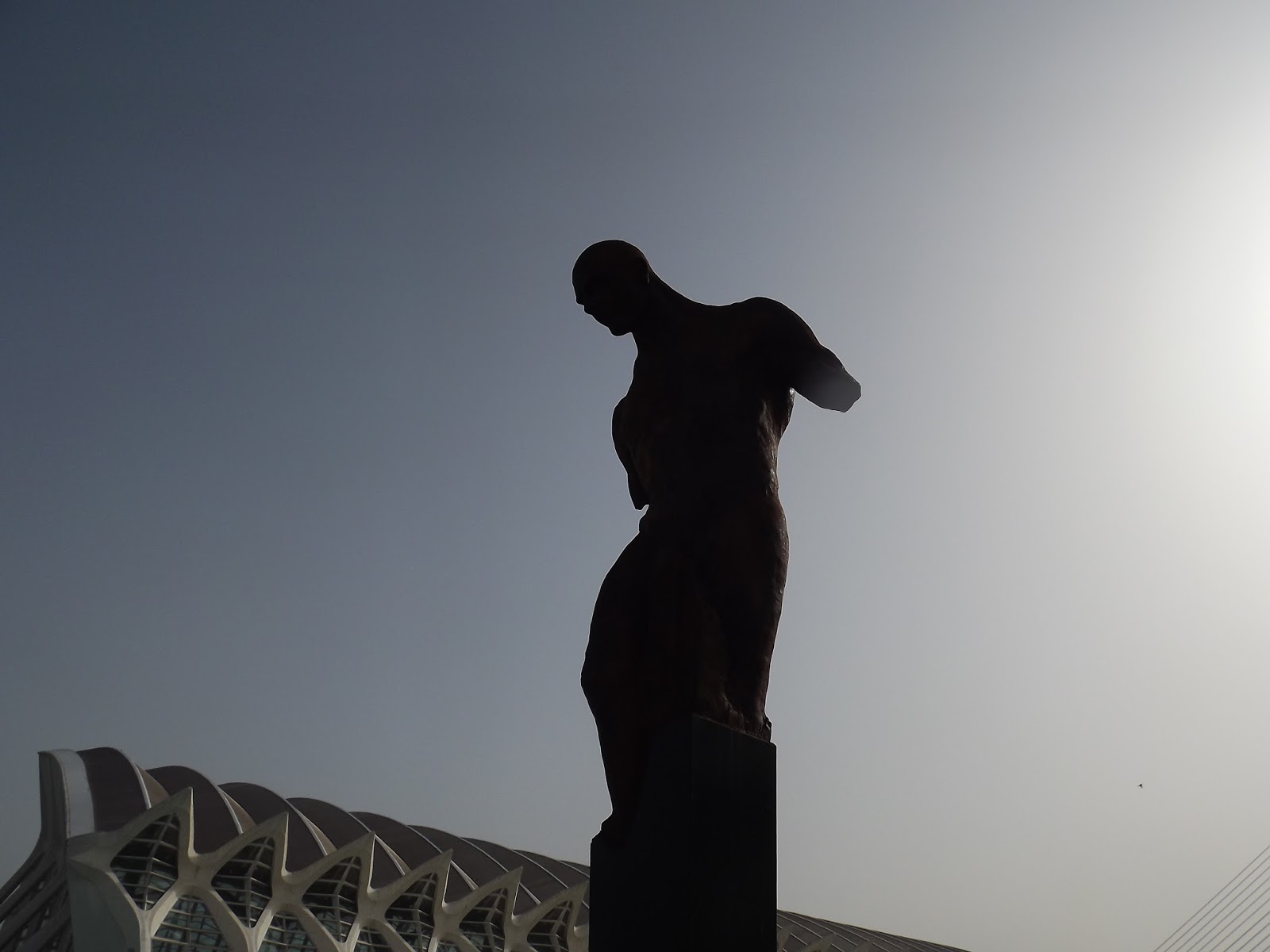
VALENCIA: SCULPTURES

Spain. The city of Valencia. If you want to pay the city of Valencia a visit, I recommend you to go to
the city of Arts and Science. I was fascinated by the new architecture and the sculptures for public viewing. Valencia is the capital of autonomous community of Valencia.About 800.000 inhabitants.
Valencia is the third largest city of Spain after Madrid and Barcelona.


SPAIN: ALBIR - A FORGOTTEN SCULPTURE?

SPAIN: ALBIR 2017
When you want to set up a new sculpture for public viewing, people get involved in the talk about where to set up the sculpture. While making my daily walk to the beach of the city of Albir , Spain, I was surprised seeing that a sculpture had been placed on the veranda of one of the buildings  close to the beach.  The balcony is not the most attactive place to put a sculpture. On the other hand: Attention was attracted by those who find the viewing of buildings an interesting business.
Albir is a tourist city situated about 65 km North of Alicante, Spain. A nice city with few scupltures set up for public viewing.


Friday, February 3, 2017

PERMISSION GRANTED TO DRINK BEER AT AN AGE OF FIFTEEN:CUBA 1963

ONLY FIFTEEN YEARS OF AGE AND  PERMITTED TO DRINK BEER: CUBA IN 1963
He was only fifteen years of age when he went ashore to make it in Havana,Cuba. The year was 1963. Too young for the hard life at sea, you may say. But he was not too young be served beer in the bars in Havana in 1963. He was not interested in politics at the time but he made his private observations about the conflict between Cuba and the United States. He  appreciated the special service he got at the bars in Havana. Due to the restricted boycott of Cuba launched by the politicians in Washington, the bars in Havana could only sell beers two days a week. But the young Norwegian sailor got beer all the days of the week because he looked so young!

The official relationship between Cuba and the United States was complicated. The Norwegian ship,” M/S Benny Viking ”  was owned by the Norwegian shipowner O.N. Henriksen situated in the city of Risør.
The young sailor had signed on the ship in New York in February 1963. When the ship came closer to Cuba, the sailors on the ship saw American fighters flying very close to  the ship for investigations of the ship. American warships were also observed by the crew as if a stage of war existed between Cuba and the United States. But how was the daily life in Havana at the time in 1963? Relaxed and very nice. I was treated very well, told the former Norwegian sailor, Asbjørn Rueslåtten ,during my conversation with him about Cuba, the war and Fidel Castro. I had a good time,he said.The city of Havana was a peaceful place even if  the American blockade of Cuba had made the daily life for people very difficult.

The Norwegian sailor, Asbjørn Rueslåtten, had joined the sea in 1962.


He signed on the famous Norwegian school ship , Christian Radich, in 1962 for about seven weeks training in seamanship.
He signed on the ship: ”M/S Benny Viking ” in 1963 as a cabin boy or a galley boy. The daily works of the cabin boy was to take part in cooking and cleaning. The crew had to get the  meals served in due time. The ship went on a voyage between the United States, Caribbean and South America. Only fifteen and ready for the life of an adult with permission to drink beer  all the days of the week! The working  hours on the ship were 14 hours a day. He began he work at 0600 and finished at about 1930. Not much time for parties and light entertainment ashore. Cuba was a nice place.People were very kind to the young cabin boy. He loved Havana, Cuba and Fidel Castro. Later on he studied the political situation on Cuba. In year 2017 he is still angry with the Americans who make life so difficult for the ordinary people on Cuba. Fidel Castro is not a target for American political assassination any more. Even during the presidency of the late President  John F. Kennedy , Fidel Castro was a target for  secrets attempts to assassinate him. In 1961, the Minister of Justice, Robert Kennedy initated the ” Operation Mongoose”  to eliminate  the new leader of Cuba, Fidel Castro. The mission failed.
The young Norwegian sailor did not know much about the dramatic political events that took place. But he disliked the close meetings with American fighters  and warships which came too close to the ship.
” M/S Benny Viking ” was a political target for those who were in charge of the blockade of Cuba. The ship was put on a list of ships not wanted for American harbours about 14 days after the visit to Cuba.
What happened to the not wanted ship? The ship got a new name: ” Benny” only. Later the ship was sold to a shipping company in Panama : ” Comp.de Nav. Indian Star Line( Trapani S.R.L) ”. The new name was: ” Stella Oceanica”.

What about the young Nowegian sailor who had a short meeting with ” Castro Cuba” in 1963? He went  on sailing as cabin boy , galley boy and a cook. He went ashore for good at an age of 22.


Cuba, Havana and the exprience with a dramatic political event are memories not forgotten by the sailor, Asbjørn Rueslåtten.
Some memories, souvenirs, from the life at sea.

Asbjørn Rueslåtten passed away on November 5, 2021.


 Asbjørn Rueslåtten was a member of Drammen sjømannsforening situated at the City of Drammen, Norway.


Asbjørn Rueslåtten on the left side of the photo and Tedd
 Urnes on the right of the photo taken during a meeting at the Drammen sjømannsforening, the City of Drammen,Norway.


Sunday, January 22, 2017

FOR OLD TIMES SAKE

For old times sake, reading  pamphlets once more to make the memory  a memory of a happy time, are time consuming but a nice work. Viping of old books , papers, written reports and pamphlets are not a business to be recommended for old librarians. No.But the limitation of space to keep the many happy hours  ofthe past is a reality to most of us who have a passion for events passed but remembered.
Once upon a time I had to go to stockholm , Sweden, to get the annual dose of professional vitamins. Once upon a time , the most brilliant television archive was to be found in Stockhom, Sweden. Once upon a time, The Film library of the Swedish Broadcasting Corporation (SRT) was the most interesting film and video library worth a visit.

My private library has no more space for the many beloved documents and books which have made my  life more than one life only. Some books had to go.But I cound not make it throwing away to small , modest pamphlets  about the Swedish television library. One of papers had been published in 1969 and the orther pamphlet was printed in 1976. What was the reason for me to keep both of the papers for so many year? First of all, my contact with film and video library began in December 1976 when I got the work as the Head of the Film and Video Library at the Norwegian Broadcasting Corporation (NRK) in Oslo. My knowledge in the field was not much at all. I had to be educated in Sweden. But I returned to Stockholm year by year. I had a good time. Reading the two small pamphlets once more for the old times sake, I do remember the nice people who worked in the archive. A good service and open information about the latest news in the field of preservation of transmitted programmes and research work was given to me. Little by little I understood the main aim of the work: Preservation of the audiovisual heritage of the nation! In year 1976 it was not an accepted   national policy among those who worked in the television companies worldwide and above all: The source was not accepted by academics  as an important source for studies.

Once upon a time I went to Stockholm…
Once upon a time I believed we might make it getting the recognition  for the work done.
I do not go to Stockholm any more. But I think the work we did is recognized  as an important contribution to the preservation of the audiovisual archives worldwide.

Thank you:Stellan Norrlander, Lasse Nilsson, Marianne Johansson, Eva-Lis Green, Ove Wahlquist, Lars-Gunnar Bengtsson, Bengt Lorentzon ,Margareta Hedlund, Myr Hamrin-Peter, Karin Strunk, Marianne Danelius, Arne Lind, Sven Allerstrand, Monica Troupp, Elisabeth Martin-Løf  and the staff who made the work a nice experience. Above all: Keep up the standard of the work  you presented to me year by year. Take care.


Wednesday, January 4, 2017

FIDEL CASTRO: MY EARLY DAYS – MEMORIES,  CUBAN HISTORY AND REVOLUTION
I do recall my first information about the late Fidel Castro.Information given about the young Cuban rebel was  presented at a cinema in the center of Oslo in about year 1956. The cinema  which presented Norwegian news reels of important events  for the Norwegian public, published also international news. We had to view shots of Cuban guerilla fighters. The shots were made in black and white films.

CUBA IN 2003
In  2003 I paid a visit to Cuba. In Habana I bought some books about  Cuba including an interesting book about Fidel Castro: FIDEL CASTO: MY EARLY YEARS. The book is edited by Deborah Shnookal and Pedro Alvarez Tabio. The first printing of the book took place in 1998.
I had forgotten the book . News about the death of Fidel Castro made me read the book once more. While reading the book, I asked myself some questions about the life of Fidel Castro, about the Cuban history and the history of the Cold War.

WHY DID HE…
-Why did he ( Fidel Casto) put his life at risk for the support of a revolution on Cuba?
-Why was he interested in changing the standard of living for the people of Cuba?
-Why supported USA the corrupt regime of Fulgencio Batista?
-USA: The official policy towards Cuba was?
- What was the main reasons for Russia to support Cuba?

Fulgencio Batista Zaldivar (1901-1973) was the elected President of Cuba from 1940 to 1944. He was dictator from 1952 to 1959. The United States supported Fulgencio Batisa. He left Cuba in 1958. No support given by U.S to Batista after the Cuban revolution. He was denied entry to the United States and Mexico.Portugal's dictator Antonio Salazar allowed him to settle in Portugal.Later on Batista moved to Spain.


FIDEL CASTRO: MY EARLY YEARS
The content of the book.
The book contains a collections of essays and interviews with and about Fidel Castro.
Some of my private questions were answered by reading the book and by viewing some documentries  dealing with the Cuban revolution.
The content of the book is:
-The Preface was written by Deborah  Shnookal in June 1998.
-”  A Personal Portrait of Fidel Castro” by Gabriel Gracia Marquez
”…His supreme aid is his memory, and he uses it to the point of abuse to sustain speeches and private conversations with overwhelming reasing and arithmetic operations of incredible speed. This task of information accumulation begins when he wakes up. He breakfasts with no less than 200 pages of news from all over the world…”. So far the opinion about Fidel Castro and his work observed by Gabriel Gracia Marquez.
-” Childhood and Youth ” –an interviewed of Fidel Castro made by Brazilian liberation theologist , Frei Betto.
” … The society in which I grew up was a society with many difficulties; the people had to make sacrifices. On reflection, that society engendered tremendous selfishness, making people want to gain something  out of every situation, rather than encouraging kindness and generosity…”
” … There are many people in the world today who call themsleves Christians but do horrible things. Pinochet, Reagan and Botha , for example, consider themselves Christians…”. Some statements made by Fidel Castro during his talk with Frei Betto.
-”  University Day ”. Speech  given by Fidel Castro to a meeting in Aula Magna(Great Hall) of the University of Havanna on September 4, 1995.
”… Don’t  take me as a role model. I don’t consider myself to be a role model, much less a model of good student. I have tried to be a good revolutionary. I have tried to be a good soldier. And if it occur to some of you to imitate a case like mine, I beg you to imitate my few successes and spare yourselves the many errors that I may have committed…” . So far Fidel Castro and his personal opinions about himself and advice to Cuban students.
-”  Colombia 1948. A Taste of Revolution  ”. An interviewed with Fidel Castro made by the Colombian journalist Arturo Alape in September 1981.
”… I ’m trying to explain a historical reality. We were told ” independence began on May 20, 1902”, the day when the United States handed us a neocolonial republic  with a constitutional amendment that gave it the right to intervene in Cuba…May 20 was the day they chose for initiating the broadcasts of Radio Goebbels, Radio Reagan, Radio  Hitler- I’m not going to call that subversive radio station ” Radio Marti ”. When the United States imposed the Platt amendment on Cuba, it had already been occupying our territory for four years. It occupied the country for four years and then imposed its infamous right to intervene in our country. It intervened more than once and seized our best land, our mines, our trade, our finances and our economy…”. Statements made by Fidel Castro about the policy of the United States in connection to the work of independence on Cuba.
-” Preparing for Moncada ”. An interviewed with Fidel Castro by Frei Betto in May 1985.
”…Some people knew what I thought and some were already trying to block me. They called me a communist, because I explained everything to everyone rather candidly.But I was not preaching socialism as the immediate objective at that time. I spoke out against injustice, poverty, unemployment, high rent, the eviction of farmers, low wages, political corruption and ruthless expoitation everywhere…” . So far Fidel Castro and the aims of his political actions.
THE MONROE DOCTRINE
To understand the official policy of USA towards Cuba , the study of the ” Monroe Doctrine ” is a must. On December 2, 1824, the American President James Monroe gave his annual message to US Congress. He presented in his speech a four- point doctrine:
1.       The continents of America were no longer to be considered as subjects for future colonization by European power.
2.       There existed in the Americas a political system that was essentially different and separate from that in Europe.
3.       The United States would consider dangerous to its peace and safety any attempt on the part Eurpean powers to extend their system anywhere in the Western Hemispher.
4.       The United  States would not interfere with existing colonies.
The aim of the Monroe Doctrine was to oppose European colonialism in the North and South America  beginning in 1823. Efforts by European nations to take control of any independent state in North or South America would be regarded as ” the manifestation of an unfriendly disposition toward the United States ”. The United States would recognize and not interfere with existing European colonies  nor meddle in the internal concerns of European countries.
The Monroe Doctrine was issued in 1823. Most of the colonies of Spain and Portugal in Latin America had archieved independence  when the doctrine was issued.

For years the people of Cuba had been told that the United States was a friendly nation. After the Spanish-American War (1897 – 1898) the Americans had made Cuba an independent nation. The war was also called ” The Splendid Little War ”. A peace treaty was signed in Paris on December 10, 1898.
The Cuban people had rebelled against the Spanish rule  of Cuba. ” The Splendid Little War ” was the war of Theodore Roosevelt. He had proclaimed the rationale of the Monroe Doctrine in supporting intervention in the Spanish colony of Cuba in 1898.
Cubans fought for independence from 1868- 1878. Americans had great sympathy for the Cuban fights against the Spanish rule of the country.
Cuba could offer USA sugar cane, tobacco, agricultural products, mineral  such as copper and nickel.
THE BATTLESHIP MAINE
On February 15, 1898, the American battleship Maine sank in the Havanna harbor. On April 25, 1898, the United States declared war on Spain. As a result of the war, Spain lost the control of Cuba.
The Monroe Doctrine had been re- interpreted to satisify the United States as a world power. The U.S was ready to make use of military strenght to force  an American viewpoint in world politics.

 " ... At the beginning of 1959 United States companies owned about 40 percent of the Cuban sugar lands-almost all the cattle ranches- 90 percent of the mines and mineral concessions-80 percent of the utilities-practicallyall the oil industry-and supplied two-thirds of Cuban' imports..." . Statements and remarks made by Senator John F. Kennedy during a Democratic dinner in Cincinnati, Ohio, October 6, 1960.Source: John F. Kennedy Presidential Library.
JOSE MARTI  AND FIDEL CASTRO. Jose Marti(1853-1895) was  a Cuban national hero. Fidel Castro admired the man. 
Fidel Castro has studied the history of Cuba. Jose Marti was a poet, an essayist, a philosopher,  journalist, a translator , a professor , a publisher, a political theorist and a revolutionary.
Fidel Castro claimed Jose Marti as a crucial inspiration for the Communist revolutionary government of Cuba.

Conclusion
We do not know much about the future of the political changes on Cuba after the death of Fidel Castro. The main questions to be asked are: Are the political systems on Cuba, the administration of different departments and officers and the present staff of persons working for the state of Cuba, ready for a close contact with the United States, the different European states who had made life on Cuba unpleasant since Fidel Castro ruled the country? How to keep up the standard of living for the majority of the Cuban people without making the economic situation worsen for the people in favour of some few rich people? How to avoid the present political situation of the countries of Latin America? Good luck, Cuba!

References

Documentaries/Movies/

-The Untold History of the Unied States by Oliver Stone.2004
-Comandante by Oliver Stone.2003
-Cuban Story. The True Story about Fidel Castro Revolution by Errol Flynn/Victor Pahlen. 1959
-Fidel:Rebellen.1996
-Dagbok från en revolution.2002
-Fidel & Che by David Attwood.2002
-Guerilla by Steven Soderbergh.2008
-Rough Riders by John Milius. 1997
-Havanna by Sidney Pollacks.1990
-Thirteen Days.2000.
-The Splendid Little War. Spanish-American War 1898 by William B. Styple. 1992
-Historias de la revolucion. Direccion: Tomas Gutierrez Alea. Productora: El Instituto Cubano del  Arte e Industria Cinematograficos ( ICAIC).1960.
-Ernesto Che Guevara. Direccion: Miguel Torres.Productora: El Instituto Cubano del Arte e Industria  Cinematograficos(ICAIC). 2000.
-The Century of Warfare. Wars in Peace 1945-89.Nr.23.

Literature/Books
-My Early Days by Fidel Castro.1998
-Dette er Cuba-alt annet er løgn. Av Vegard Bye og Dag Hoel.2000
-Las venas abiertas de America Latina( Latinamerikas åpne årer). Av Eduardo Galeano.1978.
-Retrato de familia con Fidel(Familieportrett med Fidel). Av Carlos Franqui.1982
-Verdens økonomiske og sosiale krise. Av Fidel Castro.1986.
-Che Guevara. By Andrew Sinclair.1999
-Citizen Turner. By Robert Goldberg and Gerald Jay Goldberg.1995
-One minute to midnight-Kennedy, Khrushcher and Castro on the Brink of Nuclear War.2008. By
 Michael Dobbs
 (Norwegian title: I tolvte time. Kennedy, Khrusjtsjov og Castro på randen av atomkrig. 2011. Av
   Michael Dobbs)
-Brothers.The Hidden History of the Kennedy Years. 2007. By David Talbot.


Thursday, December 22, 2016

ELTOR PROJECTOR: TOY FOR MOVIE PRESENTATIONS

I had forgotten the old projector. Eltor projector was bought by me about 60 years ago in Oslo. I had saved money for projector. Photos from movies where also a part of the deal.I had no knowledge of the films at the time I viewed the photos.I did the work to-day viewing the photos. Three important films were found. "Northwest Passage " - a historical drama where you found the famous American actors Spencer Tracy and Robert Young . The film was released in 1940. The film was popular.
The second film was the movie about Peter Pan. The cartoon movie was made in 1953. The third movie was about the famous Baron Munchhausen: The Adventure of Baron Munchausen. It was nice to play with the old toy again making me remember interesting films. The research work about the photos of old films was a nice experience. The moral: Do not throw away your toys! You might like to play once more and get new experiences. You are never too old to play it once more,Sam, for good old times.

Sunday, December 11, 2016

WHO IS CAPA, ROBERT CAPA? FORGOTTON ALREADY ?

During  the summer of 2016 I stayed in the city of Nice, France. Hunting for rare books and movies are a thrilling sport appreciated by me-an oldfashioned librarian. The target for my private research is bookshops of all kinds. In Nice I found one good bookshop.
To my surprise the bookshop had made an exhibition about the late war photographer Robert Capa. Who is Robert Capa?
He was born Endre Friedmann in year 1913. He died in 1954. Robert Capa was a Hungarian war photographer  and  photo  journalist. The bookshop sold books about him. Even if my French is not good alt all, I had to buy a book about Robert Capa: Bernard Lebrun & Michel Lefebye: ROBERT CAPA. TRACES D’UNE LEGENDE . The French text is  easy to read. Besides you find also translations from French to English. The photos published are all famous taken by Robert Capa. The story about the Hungarian refugee, Endre Friedmann, is very interesting. When he was a teenager he had to move to to Berlin, Germany,  because of the political repression in Hungary. Due to the rise of Adolf Hitler, he had to move to Paris, France. In France he invented ” Robert Capa ”. He changed his name to Robert Capa to work as a photo  journalist. The working fields for him were: The Spanish Civil War, The Second Sino-Japanese War, World War II, the 1948 Arab-Israeli War and finally: The First Indochina War.
He lived a dangerous life. He never married but his great love was Gerda Taro ( b. Pohorylle).
Gerda Taro and Robert Capa worked together as both war photographer and photo journalist. Gerda Taro was killed in an accident in Spain close to Brunete during a battle.
Robert Capa loved parties and girls. He was a restless man who was not made for marriage. The famous Swedish actress, Ingrid Bergman, was one of his mistresses.
Robert Capa is famous for his war memoirs: Slightly Out of Focus.
He  was killed by a landmine in Vietnam in 1954. He wanted always to be as close to the objects as possible. In 1954 he was too close to the object.
Forgotton, Robert Capa? No. The memory of his work and life is still a matter of interest for people in the city of Nice,  and maybe for the rest of the world too?