Ethics and competence in using archival footage.
"...The Devil is in the Details..."
The aim of
the presentation of my paper is to highlight issues related to incorrect use of
archival footage in new films, television and radio productions. New historical
documentaries are released on the market annually. National television
corporations worldwide are transmitting programmes where the content is based
on an active and creative reuse of transmitted films, radio and television
productions. The selection of the sources for the productions is an important
task. Written documents are evaluated by the producers, sound recordings are
selected and excerpts from movies and television productions are evaluated for
the new productions. My paper is a critical approach to the selection of the
sources. The written work is still the most commonly used source. Stock footage
from audiovisual archives has been used in historical movies and programmes in
an incorrect way. The story told by reusing real shots of the event must
content excerpts relating to the event. My paper is dealing with misuse and
lack of studies of dependable primary documentation. Above all: The famous
idiom: “ ...The devil is in the details ...” has been a reminder of the
research of different documentaries viewed. Unknown facts hidden in the details
must be highlighted.
The idiom " The devil is in the details"derives from earlier phrase, " God is in the detail", expressing the idea that whatever one does should be done thoroughly. For academic papers details are the essential objects for the studies.What about the production of documentaries contenting photos, sound recordings and archivaal footage from television productions and movies?
The idiom " The devil is in the details"derives from earlier phrase, " God is in the detail", expressing the idea that whatever one does should be done thoroughly. For academic papers details are the essential objects for the studies.What about the production of documentaries contenting photos, sound recordings and archivaal footage from television productions and movies?
NORWAY IN
1940 – GERMAN INVASION AND OCCUPATION OF NORWAY – CRITICAL USE OF SOURCES.
The city of
Oslo taken by a German military orchestra only?
April 9,
1940: The German attack on Norway came as surprise for the Norwegian military
leaders who were of the opinion that the main threat was Russia, not Germany.
From a military point of view, the invasion of Norway, “ Operation Weserubung” ,was a success.[1]
The German generals were told that the Norwegians would not defend themselves.
Therefore a German military orchestra was embarked on the new German cruiser “
Blucher “ . The task of the orchestra was to play and march for the people of
Oslo to make the invasion as friendly as possible. The German soldiers were
told that they came to Norway to avoid a British invasion of Norway. The German
cruiser “ Blucher “ was attacked by Oscarsborg fortress resulting in the
sinking of the ship together with the German military orchestra. When the
German soldiers arrived at Oslo there were no orchestra to play. The archival
footage showing German soldiers marching together with an orchestra on April 9
is not correct. But a new orchestra played for the inhabitants of Oslo on April
10 the very day after the invasion. It was important for the German military propaganda
to show the success of the invasion of Norway and Oslo. Therefore a new
orchestra was brought to Oslo by airplane, Junkers G.38 on April 10 to Fornebu
airport close to Oslo. The orchestra came from Fliegerhorst kommantur Staaken
close to the city of Berlin, Germany.[2]
APRIL 9 OR
APRIL 10, 1940? THE ORCHESTRA PLAYED WHEN?
New
historical documentaries are released in year 2015 dealing with Norway and The
Second World War. The story of the German in invasion of Oslo is highlighted in
more than one programme showing the German orchestra playing and marching
together with the German soldiers on the day of the invasion – April 9. The
incorrect use of archival footage creates a wrong picture of the event that
took place in Oslo, April 9. The atmosphere among people in Oslo was relaxed in
favour of the German army but not that relaxed as the official German
propaganda wanted to show.
The head of
the German invasion of Norway, Lieutenant General Nicolaus von Falkenhorst,
took it for granted that the Norwegian Government would cooperate with the
German generals. He had booked a room at KNA-Hotel in Oslo before the invasion
took place to be sure that he got a nice place to stay.
He planned
and commanded the German invasion of Denmark and Norway in 1940
He was born
Nikolaus von Jastrzembski in Breslau, Silesia ,in Prussia, January 17, 1885. He belonged to
Polish-Prussian nobility. He was promoted to Colonel General (Generaloberst)
after the invasion of Denmark and Norway. He died in 1968.

OSLO
ATTACKED BY AMERICAN BOMBERS IN APRIL 1940?
The
question has to be asked when you are viewing a newly released documentary
about Norway and the Second World War. The title of the documentary is: “ Offer
eller Spion? “ (Victim or Spy ? ). The film has been released in year 2015 for
public viewing at cinemas only. No television transmission of the film, so far.
Stock footage of aircrafts in the production is used in a way not possible for
the audience to decide the kind of aircrafts used. The Germans attacked Oslo
with Messerschmitt Bf 110c. The archival footage selected for the invasion
scene used in the film: “ Offer eller Spion ?” (Victim or Spy ?) shows the
American bombers attacking the capital of Norway, Oslo.

Boeing
B-17, Flying fortress.
“Flying
Fortress “ Boeing B-17-Fortress. US Army Air Force.
Messerschmitt
Bf 110c which was used by the Germans in April 1940 during the attack and
invasion of Norway and Oslo.

My research
for misusing of archival footage in documentaries released for public viewing
has been focusing on events related to The Second World War and Norway. My
attention is not to highlight the official content and the story dealt with in
the documentaries but important details presented as facts leading to
misinterpretations of the actual event.
GENERAL
CARL GUSTAV FLEISCHER – THE NORWEGIAN GENERAL WHO WON THE FIRST MAJOR VICTORY
AGAINST THE GERMANS IN WWII
The site is
Vadsø in Finnmark in the Northern Norway. When the Germans attacked Norway in
April 9, he was on duty in Vadsø. Due to extreme weather conditions in Vadsø he
could not leave Vadsø either by ship or by naval aircraft. He had to make it to
the city of Trømsø as soon as possible. On April 10 he managed to set off for
Trømsø by M.F11 naval aircraft. He arrived atTromsø after flying in terrible
weather conditions. As commander-in chief of the Norwegian armed forces in
North Norway in 1940, he issued orders for a total civilian and military
mobilization. The Northern Norway was declared a theatre of war.[3]
A
documentary[4]
transmitted on the Norwegian Broadcasting Corporation (NRK) in year 2015 about
General Fleischer (1883-1942) , shows that he left Vadsø by an aircraft. Take a
look at the archival footage of the aircraft used. It is a Catalina aircraft
made in Canada and not in active service in Norway in 1940. The aircraft was a
good plane. The tour to Tromsø would have been comfortable for the general
flying a Catalina aircraft. The true story is that he left Vadsø in an old
Norwegian naval aircraft: M.F. 11.
The
Norwegian general Carl Gustav Fleischer (1883 – 1942) was the first Allied
general who defeated the German Army at the Battle of Narvik in 1940 in the
Northern part of the country.


Naval
aircraft: M.F. 11
A detail
only ?– no. Making use of incorrect archival footage is the beginning of making
the real story not trustworthy. The drama of general Fleischers attempt to
reach his soldiers has been reduced from being a dramatic flight to a nice tour
lasting for about six hours with a modern plane-Catalina aircraft. The
Norwegian commander – in chief- wanted to fight the Germans as soon as
possible- and bad weather conditions were not an obstacle for making it clear
to all that Norway was at war with Germany – and not Soviet-Union. A detail
only? – no. But “ ...The devil is in the
details ...” .
THE
EVACUATION OF BRITISH, FRENCH AND ALLIED SOLDIERS IN DUNKERQUE IN FRANCE IN
1940
What about
Norwegian commandos during the evacuation from Dunkerque in France? Did
Norwegian soldiers assist the British to evacuate in France in 1940?
If you are
viewing a documentary dealing with the Battle of Britain and if you are a
strong believer of historical facts presented and published by a serious
documentary titled: “ The Battle of Britain “, you might be right. But the true
story is a different one. The Norwegian commandos were fighting at the Dutch
island Walcheren in year 1944. No Norwegian soldiers were present on the
beaches of Dunkerque in year 1940.
To control
the facts, I paid a visit to The Norwegian Defence Media Centre situated in Oslo
at Akershus Castle. The film: “ Norske commandos på Walcheren “ (Norwegian
commandos at Walcheren) was viewed by me. To my surprise I saw the same shots
used in the documentary mentioned. The film was a realistic film about the hard
fighting at Walcheren in 1944. The battle of Walcheren is dealt with by the
Norwegian writer, Arnfinn Haga, in his book: “ Klar til storm” published in
Norway in 1984.
Details
only? Details are important to any researcher wanting to report about a
historical event with the intention to be taken seriously.
US CARABINE
AND THE BRITISH MADE SUB-MACHINE GUN “ STEN GUN”
The story
of the youth of the famous Norwegian saboteur, Max Manus (1914-1996), was told
by a friend in the documentary about Max Manus: Max Manus, mannen og myten (
Max Manus, The Man and the Myth). The boys where living at Ljan that is a
residential neighbourhood in the borough Nordstrand in Oslo, Norway. Ljan is
located in the eastern rolling hillsides of the fjord Bunnefjorden. Both boys
were interesting in shooting. Max Manus owned a gun, a Winchester 22 cal. Kjell
Staff, a close friend, told a story about how they tested the shooting
qualifications of Max Manus. Archival footage is used. But we do not see the
boys making use of a Winchester 22 cal. Rifle, but a US Carabine and the
British sub-machine gun, Sten Gun. The story told in the film and the archival
footage used is not matching.This is a US Carabine which the boy to the
right in the photo is carrying.

 Max Manus is carrying a Sten Gun to the left in
the photo. We do not see any Winchester 22 cal., rifle at all.[5]
Max Manus is carrying a Sten Gun to the left in
the photo. We do not see any Winchester 22 cal., rifle at all.[5]
Max Manus was bodyguard for the Norwegian crown prince Olav in 1945. The war was finished. The crown prince was driving in an open car to be greeted by the population of Oslo. Max Manus got the work to protect the crown prince at any cost. Max Manus is armed with a Swedish submashine, Carl Gustav, not the British Sten Gun. The photo taken of the two men has been a historical source. People remember the photo. When the Norwegian periodical, History (Historie), published an article about the British submaschine Sten Gun the famous photo was used with the text that Max Manus was armed with a Sten Gun.The periodical was published in 2012, nr.18. Librarians like me want to believe in the written words. We believe that the content of the books published are more reliable that newspapers, radio news and television news.A mistake published in a book or a periodiacal might be selected as a source for future studies. The devil is there and the devil is in the details.

Crown prince Olav to the left in the photo and Max Manus to the right armed with a sub mashine made in Sweden.


Max Manus was bodyguard for the Norwegian crown prince Olav in 1945. The war was finished. The crown prince was driving in an open car to be greeted by the population of Oslo. Max Manus got the work to protect the crown prince at any cost. Max Manus is armed with a Swedish submashine, Carl Gustav, not the British Sten Gun. The photo taken of the two men has been a historical source. People remember the photo. When the Norwegian periodical, History (Historie), published an article about the British submaschine Sten Gun the famous photo was used with the text that Max Manus was armed with a Sten Gun.The periodical was published in 2012, nr.18. Librarians like me want to believe in the written words. We believe that the content of the books published are more reliable that newspapers, radio news and television news.A mistake published in a book or a periodiacal might be selected as a source for future studies. The devil is there and the devil is in the details.

Crown prince Olav to the left in the photo and Max Manus to the right armed with a sub mashine made in Sweden.
MEDIA ARCHAEOLOGY: ARCHIVAL FOOTAGE IN MOVIES
My private
collection of movies and documentaries contents about 2000 titles. The
collection has been an object for different research projects aiming at
searching for hidden archival footage used in movies and documentaries. To
search after “ the reality “ used in movies is a time consuming business. News
of events believed lost might be found in films made for light entertainment
only. The result of my private research is a list of 164 movies dating from
1941 to 2014 where I discovered stock footage used. In some movies the archival
footage has been used not to be discovered as stock footage. The viewer of the
film is not supposed to see that real news reels of events have been put together
with fictional scenes. No information about the source for the shots is given
on the credit list at the end of the film. The main reasons for making use of
archival footage are:
-For
economic reasons only. It is less expensive making copies of films made during
an historical event than to make a reconstruction of the event.
-To make
the moviegoers aware of the time of the historical events dealt with in the
film.
-To avoid
making reconstructions of the events in a studio.
-Because
the reality is better on television news than made in the film studio.
-Copyright
is no problem when it comes to German news reels from the Second World War.
-To portray
a person by using real shots of the person might make the film better than
using actors.[6]
COMBAT
SHOTS USED: A WARNING GIVEN TO THE VIEWER-THE BATTLE OF MIDWAY.
It is not
common that you find an introduction to the movie warning you that actual
combat shots are used. The aircrafts destroyed by the enemy are not fictional
scenes but real shots from the battle. The shots were taken by service men and
news people during the battle.
The
historical movie, Midway, about the naval Battle of Midway in Pacific in June
1942, was produced in 1976. A written introduction to the docudrama is
presented at the beginning of the film contenting a statement about the shots used.
Actual film shots taken during the combat are used.
...Ethical competence is a key distinguisher
between simply having skills and having a true sense of professionalism...
AN
ILLUSTRATION OF FEAR
From an
ethical point of view the sources used must be identifies clearly. “ Fear “
expressed or shown by making use of clips from movies without a note about the
title of the movies is not acceptable. “ Psycho” is a famous horror film known
by many. The scenes are well-known. Photos or clips of the face of the American
actor, Janet Leigh, expressing fear has been used as an illustration without
mentioning the original movie from which the scene is taken. The clip is put on
the final credit list at the end of the documentary but few read the credit
list. [8]

The
American actor, Janet Leigh, in the horror movie “ Psycho”.
PHOTOS OF
HISTORICAL EVENTS AND PERSONALITIES AS SOURCES FOR ACADEMIC RESEARCH
The site is
The Museum of Leon Trotsky (Museo Casa Trotsky) situated in Mexico City. I paid
the museum a visit in 2011. On the walls in one of the buildings photos of Leon
Trotsky are shown. Leon Trotsky stayed in Norway from 1935 to 1936. He had many
friends in Norway. One of the photos on the wall shows Leon Trotsky with family
and Norwegian friends having a picnic party at the sea in the southern part of
Norway in August 1936. The site is Stangnesholmen. No names of the persons are put up close to the photo.
During
research work later on I discovered that the photo had been used to illustrate
papers and books dealing with the life of Leon Trotsky making use of incorrect
information about the site for the party and of the names of the persons on the
photo.[9]
The outdoor picnic party took place close to the sea and not in the mountains
of Norway as one writer has written.[10]
The mistake
made once was repeated by writers who wanted to make use of the famous photo.
During my
private visit to the museum in Mexico City I bought a DVD about the life of
Leon Trotsky in Mexico: “ Trotsky y Mexico: Dos revoluciones del Siglo XX “,
direccion Adolfo Garcia Videla. 2007.
The photo
has been used in the documentary without any information about the content of
the photo. Besides, the photo has been made smaller. This means that an
important friend of Leon Trotsky who is sitting in a chair has been cut out of
the photo. His name is Olav Scheflo who was an important politician in the
Norwegian Labour Party. The stay of Leon Trotsky in Norway was a matter of political conflicts and debates. Editor
Olav Scheflo and editor Konrad Knudsen supported the stay of Leon Trotsky in
Norway.

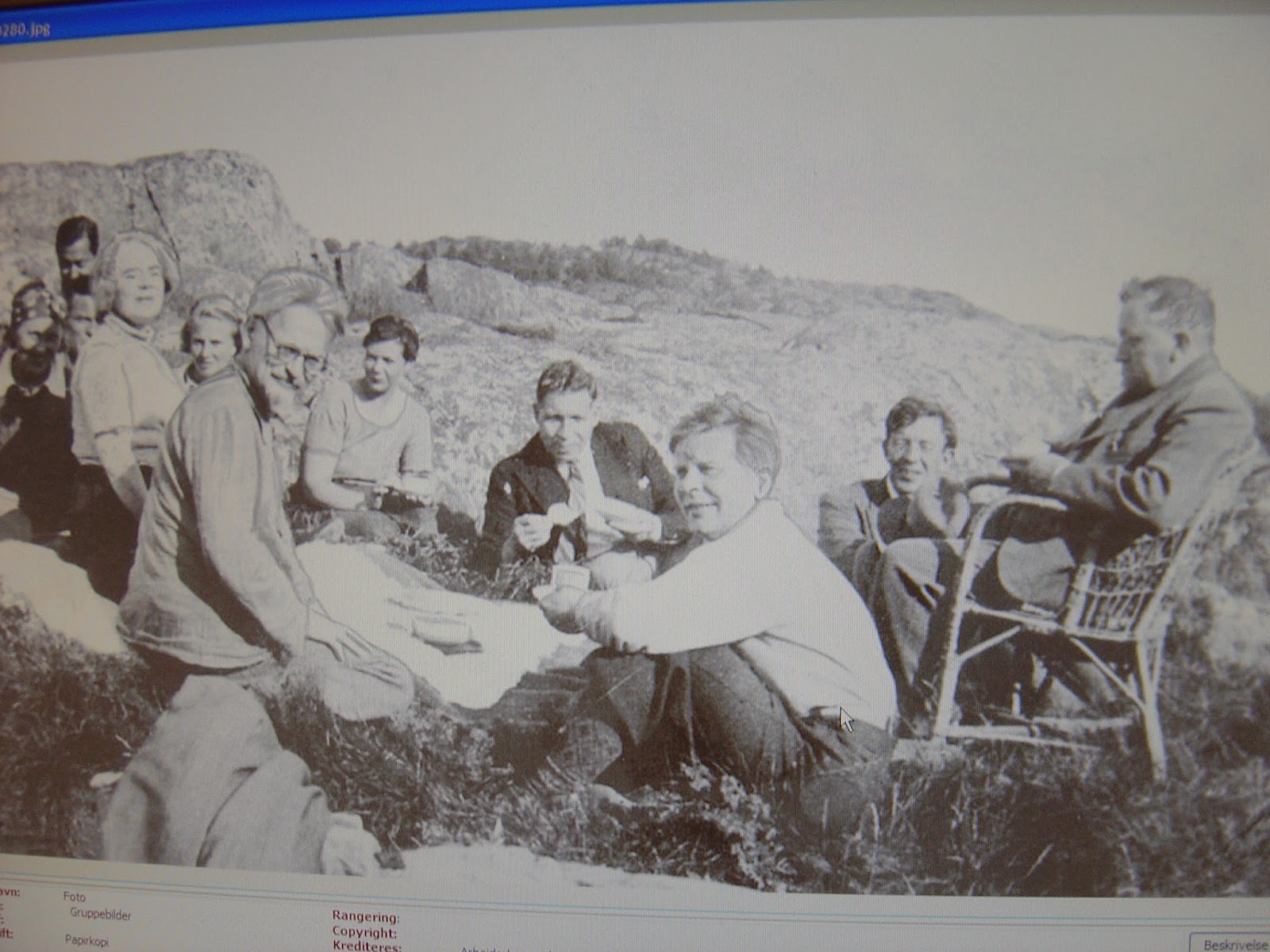
From the
left:Hilda Knudsen, Bjørn Hilt (in the background), Inge Scheflo, Natalia
Sedova, Beret(Mosse) Scheflo, Trotsky, Kathinka (Thinka) Zahl, Martin
Skjærseth(accounter in the newspaper Sørlandet), Konrad Knudsen, Botolf
Flood-Engebretsen (Samorg-sekretær)and Olav Scheflo sitting in the chair.[11]
WHO WAS
LEON TROTSKY AND WHAT WAS THE AIM OF HIS VISIT TO NORWAY IN 1935?
Leon
Trotsky was born Lev Davidovich Bronstein on November 7, 1879. He was a
Bolshevik revolutionary , Marxist theorist, an agitator, a leader in October
Revolution of 1917 in Russia and later a commissar of foreign affairs and of
war in Soviet Union. In 1929 he was removed from all positions of power and
later exiled. When he came to Norway in 1935 the aim of his visit was not to
advocate for better political relations between Norway and Soviet Union. On the
contrary: He had been expelled from the Communist Party and deported from
Soviet Union. In Norway he was a guest of Konrad Knudsen. The stay in Norway
was not a nice experience for him. In 1936 he moved to Mexico where he was
assassinated in 1940 after order from Josef Stalin.
The photo
of the picnic close to sea in Norway has been used to illustrate normal
relationship between Norway and Soviet Union in a newspaper article. The
mistake is made once more due to the fact that the content of the photo has not
been described in a correct way.[12]
CONCLUSION
The sources
presented might give you a superficial impression that the matter is of no
importance. What does it matter making use of wrong aircrafts describing
historical events? An aircraft is an aircraft, and the viewer of the movie, the
film or the television transmitted programme is not able to see the difference
between the shots due to the speed of the moving pictures. Small, invisible-
but important details have been highlighted in my paper aiming at making use of
archival footage must be dealt with in a serious way. “ ...The Devil is in the
details ...” -making use of cars, guns, aircrafts to describe an event known to
many, must not be treated as realistic as possible. If the president of any
nation is driving a car “ Ford” at an official parade, you have to get shots of
a car “ Ford” for the documentary. Above
all: We see an increasing lack of respect and recognition of the sources
selected from radio programmes, television programmes, movies among the
researchers and producers of the documentaries. Selection of photos and
archival footage means that you know what you are searching for. A practical
recommendation is to study books where you find photos of the shots you want. “
Warbirds/Illustaded .Arms and armour Press. London “ is the title of a company published books about aircrafts worldwide - a tool to be
recommended for any researcher in the business of finding good sources for the
film.[13]
Documentary
filmmakers and journalists must take full responsibility for the information
provided for the work regardless of medium. Information selected must be
verified before releasing. The sources need to be identified clearly. Visual
information, facts, photos and written documents should be treated as equal
sources for the work of the documentary filmmakers for whom ethical behaviour
is at the core of their projects. Facts or context including visual information
used must not be distorted to create a story of interest for the audience and
as a need for economic profit of the work.
[1]
Asbjørn Øksendal: Operasjon Weserubung. Vidkun Quisling og forspillet til
9.april 1940
[2]
Cato Guhnfeldt: Fornebu 9.april. Wings Forlag A/S. Page 303-306
[3]
Torkel Hovland: General Carl Gustav Fleischer. Storhet og fall.
Forum-Aschehoug. 2000. Page 82-83
[4] Makten og Æren ( The Power and The
Honour) .AS Videomaker. 2005. The documentary was transmitted by NRK in 2015.
[5]
Max Manus, mannen og myten. Dokumentar.
Prod.år.:1996
[6]Tedd Urnes: Media Archaeology: A
critical approach to the policy of active reusing of archival footage in audiovisual archives worldwide. 2010. Pages 23.
[7]Tedd Urnes: Audiovisual Archives: An
Essay on the Policies of Access to Audiovisual Archives for Academics,
Teachers, Researchers, and Students. IASA Journal, no 43, January 2014. Page 80
-88.
ADDITIONAL INFORMATION: THE STORY OF ARCHIVAL FOOTAGE OF A FAMOUS AMERICAN AIRCRAFT
The
Untold History of the United States is documentary series directed, produced
and above all: Narrated by Oliver Stone. The film is devoted to fostering
critical thinking and debate about US foreign policy during the past few decades.
The series contains no interview subjects. The introduction to and the
conclusion of the series are made by Oliver Stone himself. Each episode
consists of archival material: Stock shots, photographs, video and audio
recordings, computer generated maps, diagrams, and clips from fictional movies.
Oliver Stone has used clips from about 60 fictional movies and television shows
in the documentary about the history of United States. Archival footage shows
American dive-bombers, Douglas SBN Dauntless, in action.


Pearl
Harbour is attacked in 1941 by American aircrafts?
The
listed documentaries and movie have used the same archival footage as the series about the history of United States
produced by Oliver Stone: “ From here to Eternity” (movie), “ The Century of Warfare
“ , “ SEMPER FI: The United States Marines in World War II” and “ Days that
shock the World. Attack on Pearl Harbour “. The American dive-bombers , Douglas
SBN Dauntless, are seen in action in all mentioned productions.
Documentary filmmakers must verify information before the final releasing of the film because -as mentioned- " The Devil is in the details". The correct use of sources is important for the content of
any audiovisual archives worldwide.
Tedd Urnes
Teddview Audiovisual Archival Management (TAAM)
July 6, 2015
Documentary filmmakers must verify information before the final releasing of the film because -as mentioned- " The Devil is in the details". The correct use of sources is important for the content of
any audiovisual archives worldwide.
Tedd Urnes
Teddview Audiovisual Archival Management (TAAM)
July 6, 2015
[8] The Untold History of the
United States. Documentary by Oliver Stone.
[9]Joar
Hoel Larsen: ”Gjentar historien seg? Fra Leo Trotskij i 1936 til Dalai Lama
2014”
[10]
Modkraft.Dk-Progressiv portal
[11]
Oddvar Høidal: Trotskij i Norge. Et sår som aldri gror. 2009. p. 224
[12]
Klassekampen, 16.juni 2015: Tina Åmodt: Frykt og forventninger.
[13] Tedd Urnes: Television Archives:
Content description of the collection of television archives. 2010.


